
Reviewed · LUXOR TOURS
Private Full-Day Luxor Highlights East and West Banks
Luxor’s best sights are split by the Nile, and this private full-day tour brings both banks into one well-planned day. You’ll enter royal tombs in the Valley of the Kings, stand beneath Karnak’s huge columns, and finish among the statues and obelisks of Luxor Temple. The guide is the key: names praised for clear, engaging explanations include Mahamoud, Ameen, Hassan, Ragab, Khalid, Abdul, and Hamdee.
I like the private format, which lets you ask questions, slow down for photographs, or keep moving when the heat builds. I also like that lunch, hotel transfers, and a dedicated Egyptologist guide are included for $65 per person. The main caution is that all entrance fees are extra, and the day can include a stone shop stop unless you make your preference clear.
Key points at a glance
- Four royal tombs are part of the core Valley of the Kings visit, with an optional extra ticket for Tutankhamun’s tomb.
- The East and West Banks are covered in one day, including Hatshepsut, the Colossi of Memnon, Karnak, and Luxor Temple.
- Private guiding makes a real difference, especially inside tombs where decoration can otherwise look like a blur of symbols.
- Lunch and hotel pickup are included, a useful saving when you are trying to fit a lot into one day.
- Entrance tickets are not included, so budget for the sites you choose, especially Tutankhamun’s tomb.
- The pace can be adjusted, but this is still a full day of walking, heat, stairs, and ancient stone.
Why this tour works for a first day in Luxor
Luxor is not one compact archaeological park. The West Bank holds the royal tombs and mortuary temples, while the East Bank contains the great religious complexes of Karnak and Luxor. Moving between them on your own takes planning, transport, and a fair bit of ticket knowledge.
This tour solves the basic problem. You are collected from your Luxor hotel at about 8:00 a.m., travel in a private air-conditioned vehicle, and have a guide with you for the major sites. The day lasts about eight hours, although the detailed plan describes roughly seven hours of guided touring, so allow a little flexibility.
At $65 per person, the value is good if you want the main sights in one day. You are paying not only for transport, but also for a private guide, lunch, and the ability to shape the day around your group. The price looks less complete once tickets are added, so compare the total cost rather than treating $65 as the final bill.
The strongest part of the experience is the guiding. Hassan is praised for mixing information with humor. Ragab is described as clear and well informed, with a relaxed habit of explaining a site before giving you time to wander. Hamdee is noted for reading the group’s pace rather than filling every quiet moment with facts. Those qualities matter in Luxor, where a good explanation can turn a pile of stones into a place with purpose.
More full-day trips in Luxor:
- Luxor: Shared Full-Day Tour to Luxor West and East Banks
★ 4.5 · 1,812 reviews - Full Day Tour to East and West Banks of Luxor
★ 5.0 · 1,449 reviews - Luxor : Full Day Tour to Luxor West and East Banks & Lunch
★ 5.0 · 870 reviews
Valley of the Kings: four tombs, not just one famous name
Your West Bank morning begins at the Valley of the Kings, the ancient burial ground for New Kingdom pharaohs. The standard plan includes four royal tombs, with the exact selection centered on Ramses IV, Ramses III, Merenptah, and another royal tomb available on the day.
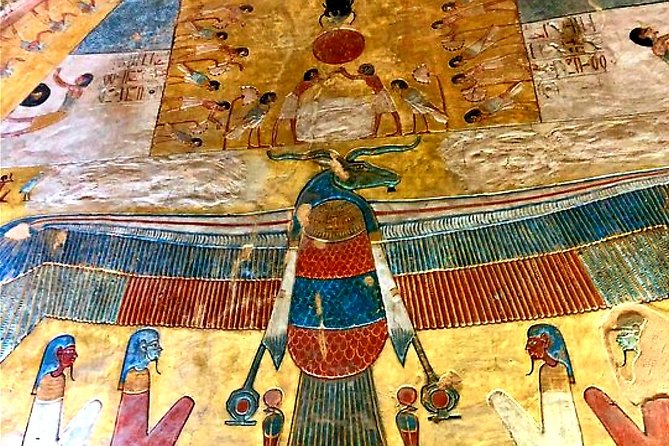
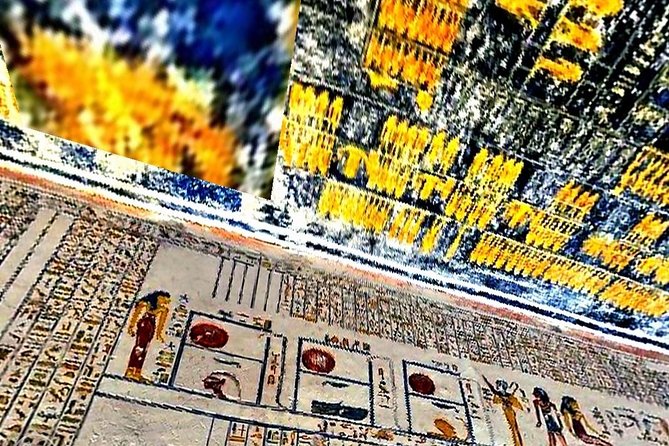
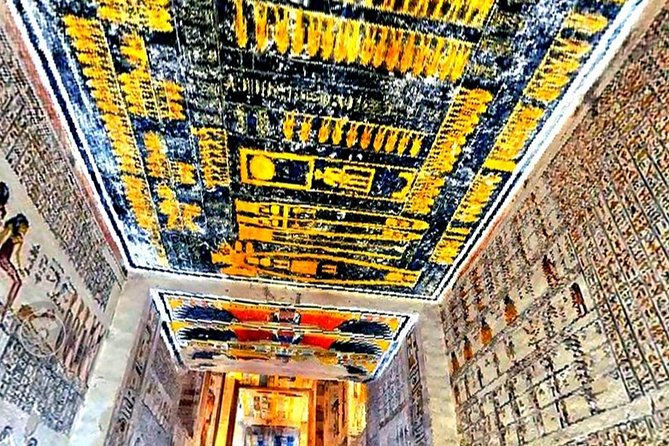
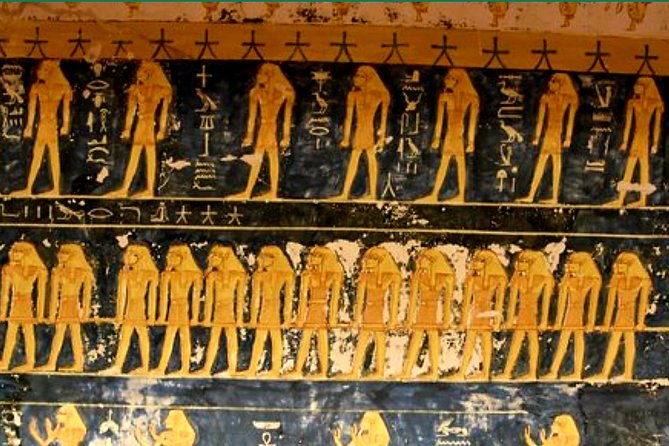
The tomb interiors are the real prize. Their corridors descend into the rock, and the walls carry scenes from religious books, ritual texts, gods, and the king’s journey after death. You will not simply walk through empty chambers. You will see how color, writing, and placement worked together to protect the pharaoh in the next world.
Ramses IV
The tomb of Ramses IV is given about 25 minutes, longer than several of the other tomb visits. That makes sense. Its walls carry scenes from the Litany of Ra, the Book of the Dead, the Book of Caverns, the Book of the Heavens, the Book of Amduat, and the Book of the Night.
Look up in the burial chamber for the image of Nut, the sky goddess, shown swallowing the sun and giving birth to it again. The rose-colored granite sarcophagus and blue and white decoration make this one of the more rewarding chambers on the route.
Ramses III
Ramses III’s tomb has a long corridor and colorful sunken reliefs. Along with the expected religious scenes, the smaller side chambers show foreign tribute, pottery, boats, military equipment, and blind harpists. Those secular details are especially useful because they give you glimpses of royal life beyond the formal images of gods and kings.
You get about 15 minutes here. That is enough for a guided look, but not enough for a slow study of every wall. If a particular tomb catches your attention, tell your guide. A private group has more room to adjust than a large coach party.
A few more Luxor trips worth putting side by side
- Hurghada: Luxor Valley of the Kings & Tutankhamun Tomb Trip
★ 4.7 · 13,208 reviews - Luxor Day Trip from Hurghada Small Group & Tutankhamun Tomb
★ 4.8 · 5,366 reviews - Hot Air Balloon Ride in Luxor Egypt with Transfers Included
★ 5.0 · 4,319 reviews - Small group Hurghada to Luxor, Valley of the Kings by Van
★ 4.5 · 2,470 reviews
Merenptah
Merenptah was the son of Ramses II, and his tomb differs from the others in its shape and scale. The corridors rise higher, while the number of side rooms drops. The tomb was discovered by Howard Carter in 1903, before his later fame from the discovery of Tutankhamun’s tomb.
The visit is listed at about 15 minutes. That is a short stop, but it gives you another example of how royal tomb design changed over time.
Tutankhamun’s tomb: an optional, highly personal stop
Tutankhamun’s tomb is not included in the tour price or standard admission. The additional entrance fee is listed as 300 Egyptian pounds, and the visit takes about 15 minutes.
The tomb is smaller and less decorated than some of the grander royal chambers, but it carries an unusual pull because Tutankhamun’s mummy remains there. You can come face to face with the young king, who took the throne at about age 10 and died at about 19.
I would treat this as an optional choice based on your interests and budget. If you want to see the actual burial place of Egypt’s most famous pharaoh, the extra ticket may feel worthwhile. If your priority is the finest wall decoration, Ramses IV or Ramses III may offer more to study.
Entrance fees for the Valley of the Kings tombs are also separate. Your guide can help with tickets, which is useful when you are deciding which extras to add, but you should carry enough money for the admissions you want.
Hatshepsut’s temple and the monuments of the West Bank
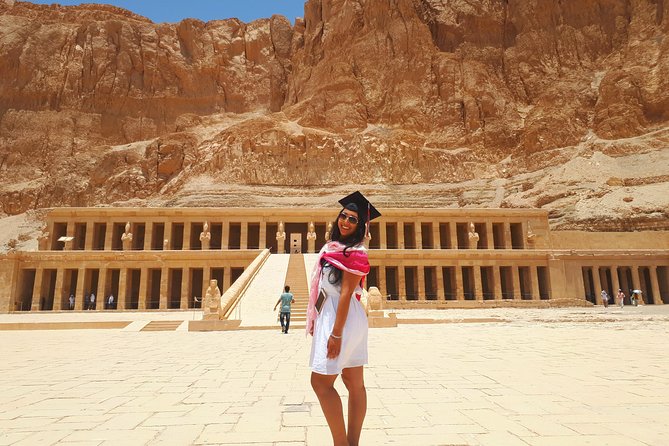
After the tombs, the route continues to the Temple of Hatshepsut at Deir el Bahari. The temple is built against a dramatic wall of cliffs, with broad terraces and long lines that make it feel very different from the underground tombs.
Hatshepsut ruled Egypt as pharaoh, an unusual achievement for a woman in ancient Egypt. She was also an ancestor of Tutankhamun, linking this stop to the famous young king you may have just visited.
Plan on about an hour here. The open terraces mean sun exposure, so a hat, water, and sensible footwear are practical. Your guide can explain the queen’s rule and the temple’s role, then give you time to take in the setting and photograph the terraces.
The day may also include extra West Bank sights such as the Tombs of the Nobles, the Carter House, the Temple of Merenptah, the Temple of Ramses II, the Mortuary Temple of Seti I, Al Asasif, or additional tombs such as Ramses VI and Ramses IX. The supplied schedule lists these places without fixed times, so do not assume every one is guaranteed in addition to the main stops. Ask your guide at the start which sites are planned for your date.
The Colossi of Memnon is a shorter stop, about 10 minutes. These two huge seated statues date from the reign of Amenhotep III. They once formed part of a larger temple complex, and their scale gives you a quick sense of how ambitious royal building projects were. This is mainly a photo stop, not a long guided visit.
Lunch on the West Bank
Lunch is included, which keeps the day moving and removes one decision during a packed schedule. Several positive comments focus on the meal, including one report of a local restaurant on the West Bank that offered a useful glimpse of everyday life in Luxor.
Expect the meal to be practical rather than a carefully designed culinary event. One less positive account called lunch very basic, so keep your expectations sensible. The value is the convenience and the break from sightseeing, not a guarantee of a memorable feast.
One group also enjoyed an unexpected boat ride across the Nile after lunch. Do not count on that as a standard inclusion, since the official inclusions list transport and lunch, not a boat trip. If crossing the river by boat matters to you, ask before the day begins.
Karnak: the day’s biggest monument
Karnak is not a single temple. It is a vast religious complex built and expanded by many rulers. The visit is scheduled for about two hours, making it the longest stop of the day and one of the places where a private guide earns the fee.
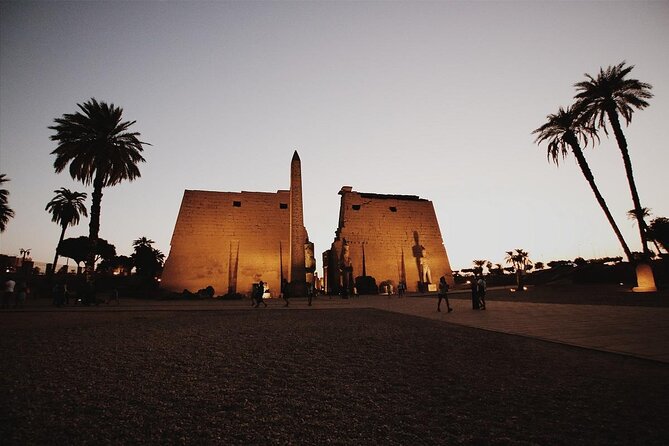
The Avenue of Sphinxes leads into the complex. You will see the enormous Hypostyle Hall, filled with 134 columns, along with obelisks linked to Hatshepsut and Thutmose I. The Temple of Amun includes lotus and papyrus designs, while the Sacred Lake and the granite scarab of Amenhotep III add more stops to the walk.
Karnak can overwhelm you at first. There are columns, broken walls, statues, reliefs, and open courtyards in every direction. A guide helps you focus on the main route and understand that the site grew over centuries rather than being built as one tidy project.
The itinerary separately mentions the Temple of Ramesses III, the Temple of Amun, Hatshepsut’s obelisk, and Thutmose I’s obelisk. These are parts of the wider Karnak visit, not separate full excursions. The short five and ten-minute entries indicate brief looks within the complex.
Give yourself time to stop under the columns and look closely at the carved surfaces. The scale is impressive from a distance, but the details are where the site becomes easier to understand. Some entrance fees are extra, and the guide can direct you through the ticket process.
Luxor Temple and the Avenue of Sphinxes
Luxor Temple is a fitting final major stop. Dedicated to the Theban Triad of Amun-Ra, Mut, and Khonsu, it has a different feel from Karnak. The complex is more compact, and the granite statues of Ramses the Great and the tall obelisks make the main approach easy to read.
The visit lasts about an hour. You can expect a guided explanation of the temple’s religious role, followed by time to look at the columns, statues, and inscriptions.
The Avenue of Sphinxes once connected Luxor Temple and Karnak over a distance of roughly three kilometers. Only a shorter restored section is covered on this visit, and it is listed as a free 15-minute stop. It gives you a clear sense of the ceremonial link between the two temples without requiring a long walk between them.
The obelisks of Hatshepsut and Thutmose I are also listed as free viewing stops. These are brief moments rather than separate ticketed attractions, so think of them as part of the East Bank route.
How the private format affects the day
A private tour is most useful here because your guide can explain first, then let you explore. That pattern came up repeatedly in the feedback: the best guides, including Ragab, Hamdee, and Abdul, were praised for answering questions without forcing a fixed pace.
You should still speak up. Tell the guide if you want more time in a tomb, fewer details, or a shorter visit in the midday heat. The tour is private, but it is also ambitious. You will cover a lot of ground in about eight hours.
The vehicle is described as air-conditioned, and hotel pickup and drop-off in Luxor are included. One complaint reported no air conditioning, while the company response said the group had requested fresh air instead. The sensible move is to confirm your preference at pickup, especially during the hot months.
The route involves walking on uneven ground, standing in the sun, and entering tombs with sloping passages. The tour data says most people can participate, but it does not give a detailed mobility assessment. If stairs, heat, or long walks are a concern, ask the operator before booking.
The stone shop concern
A few experiences include a stop at a stone figure shop. One account described feeling pressured to buy items and frustrated because prices were not stated clearly. Another said the only thing they would skip was the stone shop.
This is the main quality-control concern in an otherwise well-received tour. A shopping stop is not listed among the inclusions, and you are not required to buy anything. Tell the guide early that you want an archaeology-focused day with no shopping, and ask whether the stop can be removed.
That small conversation can protect both your time and your mood. After a morning among royal tombs, spending energy negotiating over souvenirs is not everyone’s idea of a good use of the day.
Who should book this Luxor tour?
I would choose this tour if you have one full day in Luxor and want the essential East and West Bank sights without arranging separate taxis, guides, and meals. It is also a strong fit for families or mixed-interest groups because a private guide can adjust explanations and walking time.
It suits first-time visitors particularly well. The guide handles the geography, ticket process, and order of stops, while you concentrate on the monuments. The past guide assignments show a deep bench of experienced names, including Mahamoud, Ameen, Hassan, Ragab, Khalid, Abdul, and Hamdee.
You may want a different plan if you prefer a slow archaeological study of only two or three sites. Karnak alone can occupy much of a day for someone who wants to inspect every wall, and the Valley of the Kings rewards patience. This route favors breadth, with enough time at the main sites but not unlimited time everywhere.
At $65 per person, the tour offers solid value before admissions. Add the entrance fees, optional Tutankhamun ticket, gratuity, and any personal purchases when calculating the real cost. Free cancellation is available up to 24 hours before the start time, which gives you some useful flexibility.
Should you book it?
Book it if you want Luxor’s major monuments in one private day, value clear historical guidance, and appreciate having lunch and hotel transport handled. The best evidence of quality is the repeated praise for guides who explain well, answer questions, and leave room for independent looking.
Before you go, confirm the day’s exact stops, ask to skip any stone shop, clarify the vehicle’s air-conditioning arrangement, and decide which extra tomb tickets you want. With those points settled, this is a practical and good-value introduction to Luxor’s two banks.
FAQ
How long does the Luxor tour last?
The experience lasts about eight hours. The detailed touring plan describes approximately seven hours of guided touring, with pickup and drop-off included.
What time does the tour start?
The listed start time is 8:00 a.m.
Does the tour pick me up from my hotel?
Yes. Hotel pickup and drop-off in Luxor are included.
Is this a private tour?
Yes. Only your group participates, with a private Egyptologist guide and private transport.
Are entrance fees included?
No. All entrance fees are paid separately. The optional entrance fee for Tutankhamun’s tomb is listed as 300 Egyptian pounds.
Is Tutankhamun’s tomb included?
No. It is an optional stop with a separate entrance fee. The visit is listed at about 15 minutes.
What sites are included in the main route?
The main route covers the Valley of the Kings, Hatshepsut’s temple, the Colossi of Memnon, Karnak Temple, Luxor Temple, the Avenue of Sphinxes, and several obelisks and structures within the Karnak complex.
Is lunch included?
Yes. Lunch is included in the tour price.
Can I cancel the booking?
You can cancel up to 24 hours before the experience start time for a full refund. Cancellations or changes made less than 24 hours before the start time are not accepted for a refund.
Just added for Luxor
- Full-Day Luxor private Tour from Cairo by Plane with Lunch★ 5.0 · 446 reviews
- Private Day from Cairo to Luxor by plane with hotel,balloon,west,east and lunch★ 4.5 · 199 reviews
- From Cairo Private Luxor Full-Day Tour with Guide and Flights★ 5.0 · 124 reviews
- Day Trip To Luxor From Cairo By Plane★ 4.5 · 393 reviews
- Day Trip To Luxor From Cairo By Plane Including Lunch★ 4.5 · 92 reviews
- Day Trip to Luxor From Cairo By Flight, King Tut Tomb Included★ 4.5 · 270 reviews
- Incredible 7 Days Tour around Cairo, Luxor, and Hurghada★ 5.0 · 117 reviews
- Private 3-Days Nile Cruise to Luxor with Hot Air Balloon Ride★ 5.0 · 88 reviews
Luxor Tours, compared.
Luxor Valley of the Kings & Tutankhamun Tomb Trip
Read our review →
Luxor Day Trip from Hurghada Small Group & Tutankhamun Tomb
Read our review →
Hot Air Balloon Ride in Luxor Egypt with Transfers Included
Read our review →
Small group Hurghada to Luxor, Valley of the Kings by Van
Read our review →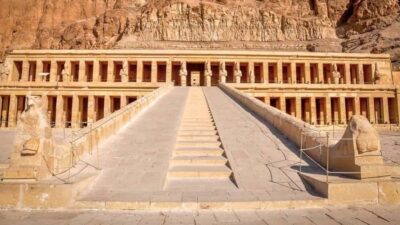
Shared Full-Day Tour to Luxor West and East Banks
Read our review →
Luxor Day Tour: Valley of Kings & Queens & Hatchepsut Temples
Read our review →
Full Day Tour to East and West Banks of Luxor
Read our review →Browse the lists this tour appears in