
Reviewed · MEDINA & SOUK TOURS
Fes: Medina Guided Tour with Local
Fes is easiest to understand from inside its maze of lanes, and this walking tour puts you beside a guide who grew up there. Mohammed leads you from Bab Boujloud through souks, mosques, craft workshops, tanneries, and quieter corners that are hard to find alone. The medina is huge, with thousands of lanes, so a local who knows the shortcuts can save you both time and confusion.
I like two things right away: the strong local connection and the lack of shopping pressure. Mohammed is an official licensed guide and an artisan with a particular interest in tile, carved plaster, and Moroccan craftsmanship. He explains how the city works, answers questions plainly, and introduces you to everyday places without turning every stop into a sales pitch.
The main consideration is the walking. Fes El Bali has uneven paving, narrow lanes, stairs, crowds, animals, and little room to pause. The tour is not suited to people with mobility impairments, and the full-day option can be tiring in hot weather.
What makes this Fes tour worth your time

- Mohammed grew up in the Fes Medina, giving you a guide who knows both the monuments and daily life inside the old city.
- The half-day route covers the major sights, including Bou Inania Medersa, Kairaouine, the Nejjarine Fountain, Place Seffarine, and Chaouwara Tannery.
- The tour avoids compulsory shopping stops, while still showing you real craft production in pottery, mosaics, bronze, tile, and plaster.
- The full-day option adds a different side of Fes, with the Jewish Quarter, the Royal Palace, Bab Guissa, and the Marinid Tomb viewpoint.
- The pace can be adapted, with time for photographs, questions, local food suggestions, and extra stops when the schedule allows.
- At $22 per person, the tour is particularly good value if you are new to Fes and want to cover the old city efficiently.
Starting at Bab Boujloud, the Blue Gate
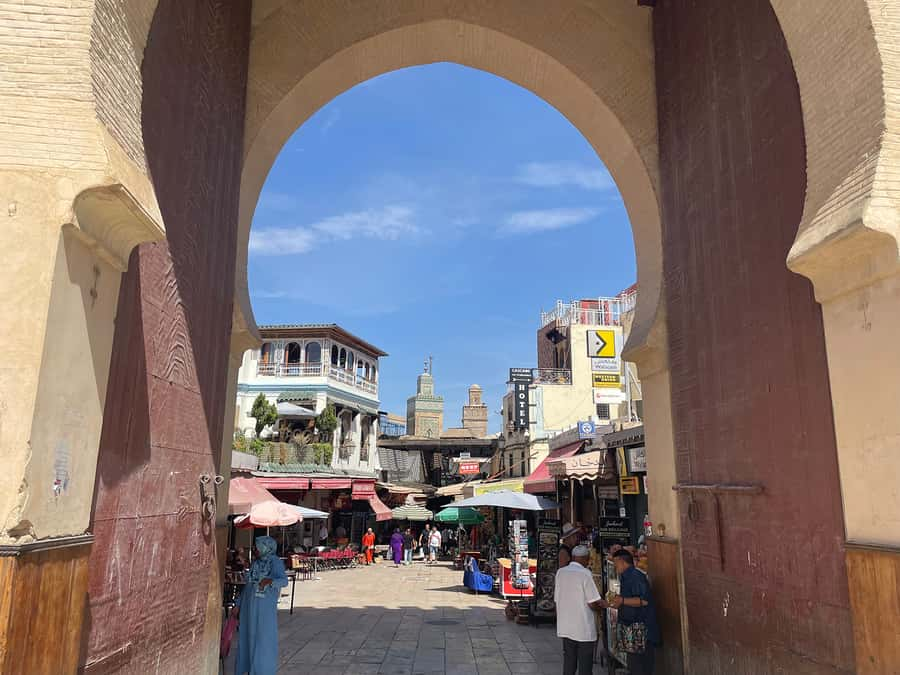
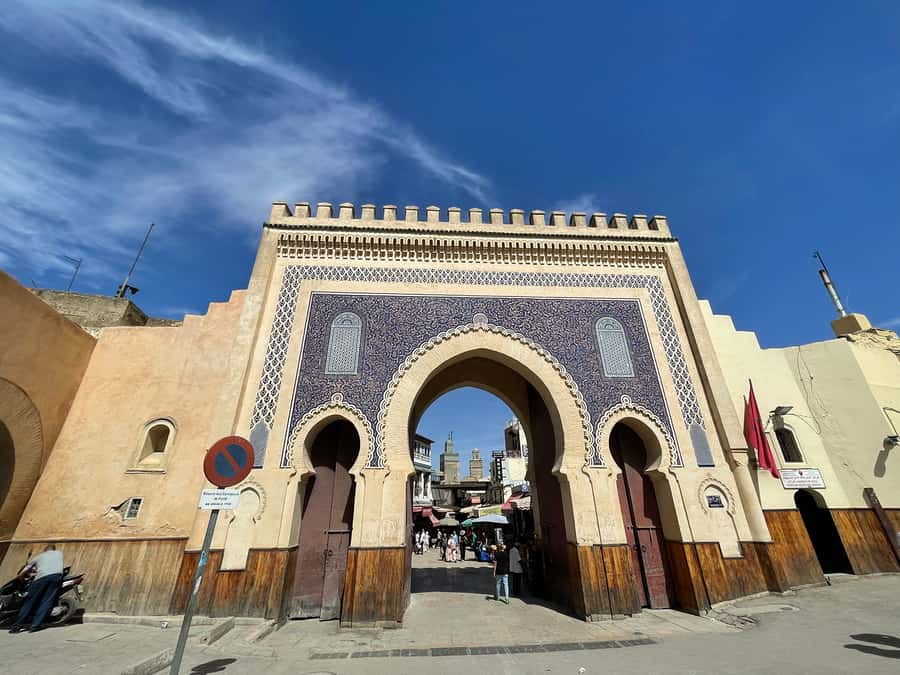
The classic half-day tour begins at Bab Boujloud, the Blue Gate, one of the most useful landmarks in Fes. It is more than a photogenic entrance. It gives you a clear starting point before the lanes tighten and the city begins to feel like a puzzle.
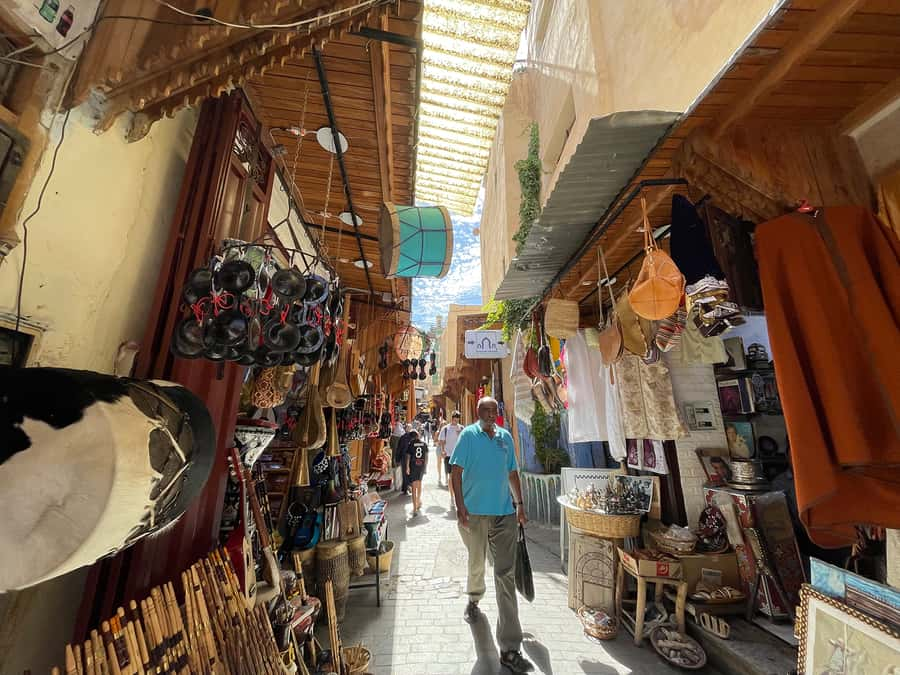
From the gate, you turn onto Talaa Kebira, the main uphill street through the medina. This first stretch is a quick lesson in Fes life: herbal shops, food stalls, local souks, small workshops, and handicraft stores all share the lane. You will see how little separation there is between commerce, home life, and religious buildings.
The meeting point is at Dar Sunrise, house number 10, in an alley beside the Made in M cafe. From Bab Boujloud, cross through the gate, turn into the first street on the left, and walk for about three minutes along Talaa Kebira. If you are coming from Ain Zliten Parking, enter Talaa Kebira and walk uphill for about one minute. The directions are useful because a Medina address can be hard to locate without a visual landmark.
More Medina & Souk Tours in Fez
- Fez Medina Guided Tour
★ 4.6 · 2,079 reviews - Fes: Museum, Al Attarine Madrasa & Tannery and Medina Tour
★ 4.6 · 1,655 reviews - Explore Fes: Unforgettable Guided Walking Tour of the Medina
★ 4.7 · 1,339 reviews
Bou Inania Medersa and the old city’s first lessons
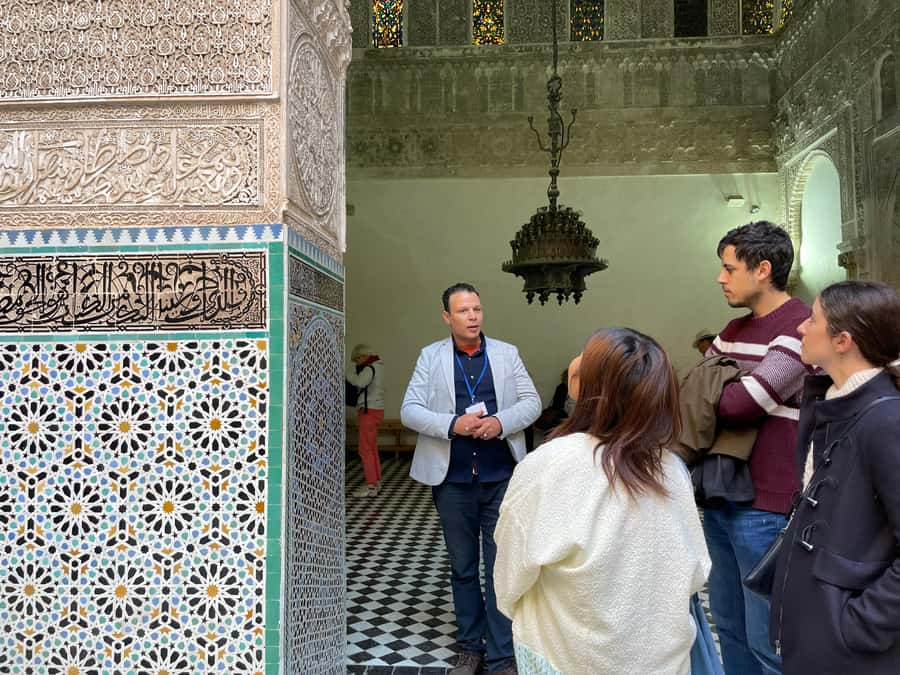
One early stop is the Bou Inania Medersa, a former religious school known for its tilework, carved plaster, and cedar details. The entry fee is listed separately at €4 for the madrasa and museum, so keep some cash ready.
This is where Mohammed’s craft background adds real value. A guide can point out the difference between decorative elements at a glance, but a guide who works with Moroccan design can also explain the labor and skill behind the patterns. You will hear more than a list of dates. The focus includes materials, technique, religious design, and the place of artisans in Fes society.
The tour also passes the old water clock. It is an easy landmark to miss when you are busy watching foot traffic, shop displays, and doorways. Having someone explain what you are looking at helps turn a quick walk into a sequence of connected details.
Kairaouine, Andalusian Mosque, and the heart of Fes
The route continues toward the Mosque and University of Kairaouine, one of the city’s best-known religious and intellectual centers. The mosque is an important part of Fes, but access to religious interiors can be limited, so your guide’s explanation outside matters.
You also see the Andalusian Mosque, another major religious landmark, and learn how different quarters of the old city developed around institutions such as mosques, schools, markets, and fountains. The value here is context. Without a guide, you might see a grand doorway and take a photograph. With an explanation, you begin to understand why the building sits where it does and how it relates to the surrounding neighborhood.
The route is compact on a map but not always easy underfoot. Lanes bend sharply, surfaces are uneven, and there are frequent interruptions from people moving goods. You should wear comfortable shoes and avoid carrying anything bulky.
Nejjarine Fountain, Museum, and the craft quarters
The Nejjarine Fountain is one of the memorable decorative stops along the route. Its tiled surface and carved wood details show the level of finish found across Fes. Nearby, the Nejjarine Museum gives you a closer look at Moroccan woodwork and traditional objects. Museum entry is not included, and the listed fee is €4 for the madrasa and museum.
From there, the walk threads through the Henna Souk and Attarin Market. These are not just shopping streets. They show how the medina organizes trade by product and craft, with certain lanes associated with particular goods and working traditions.
I would tell you to decide in advance how much shopping you want. The tour is designed around sights, culture, and craft rather than forced purchases, but you will pass plenty of tempting displays. Mohammed’s usual approach is to explain what you are seeing and let you choose. He can also advise you about buying and bargaining if you ask.
More Medina & Souk Tours in Morocco
- Fes: Royal Palace, Madrasa, Tannery & Souks and Medina Tour
★ 4.5 · 508 reviews - Exclusive Fez Medina Walking Tour with Private Guide
★ 5.0 · 392 reviews - Fez: Guided Walking Tour of the Historic Medina
★ 5.0 · 359 reviews - Fez Medina 4-Hour Guided Walking Tour
★ 4.5 · 248 reviews
Place Seffarine and the sound of bronze

Place Seffarine is one of the most atmospheric parts of the walk. Here, bronze workers shape and finish metal objects in plain view. The sound of hammering makes the craft feel immediate, not staged for a museum display.
The square is also home to Saffarin Madrasa. This stop gives you a useful contrast with the commercial lanes. You see both the formal beauty of a religious school and the practical work of artisans who continue old production methods.
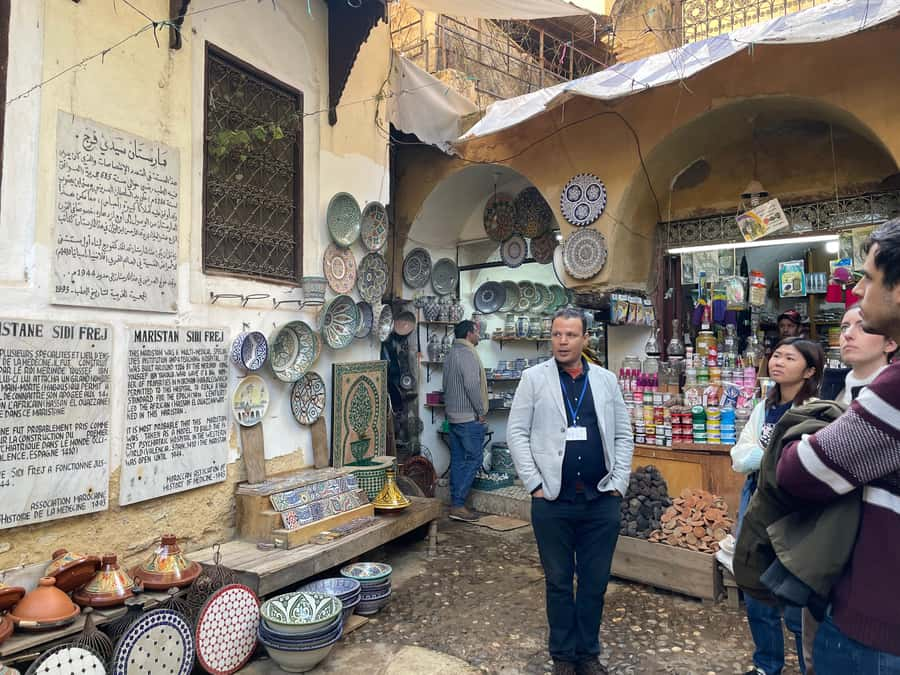
Several accounts of the tour describe introductions to craftsmen, pottery workers, traditional ovens, and other local workspaces. These visits are valuable because they connect the polished architectural details you see in the medina with the people and tools needed to make them. The key distinction is that the guide’s craft stops are intended to show a process, not to pressure you into buying.
Chaouwara Tannery, the most famous stop
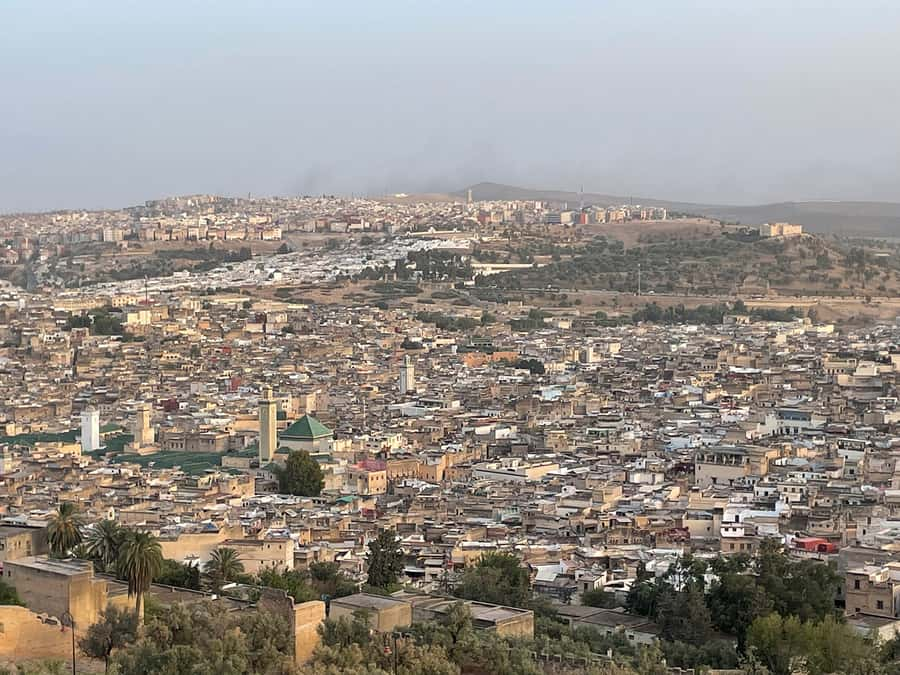
Chaouwara Tannery is usually the big visual moment. It is the largest tannery in Fes, with rows of dyeing vats and leather work carried out in the traditional manner. From an upper viewpoint, you can see the colors and layout that make the site so recognizable.
The visit can involve a shop viewpoint, so this is a good place to be clear about your preferences. The tour information and direct accounts emphasize that shopping is not compulsory. You can look, ask questions, and leave without purchasing leather goods.
Expect strong smells around the tannery. That is part of the working process, not a flaw in the tour. Take the mint offered at some viewpoints if available, but remember that the tannery is an active work area rather than a quiet monument.
The full-day route adds a wider view of Fes
The half-day tour is the practical choice if you have limited time. It lasts about three hours, though the actual pace may stretch longer when the group has questions, takes photographs, or adds a short stop. Several tours have run close to four or five hours, which can be welcome if you are enjoying the walk but may affect later plans.
The full-day version continues after the medina. You visit the Jewish Quarter and the Royal Palace, then stop at a mosaic and pottery factory. This adds a different layer to the city. The medina shows religious buildings, markets, and workshops packed into narrow lanes, while the Jewish Quarter helps you consider Fes as a city shaped by more than one community.
The Royal Palace is viewed from outside. Its gates are the main attraction, and the stop is best treated as an architectural and photographic visit rather than a palace tour.
The day also includes panoramic viewpoints at Bab Guissa and the Marinid Tomb. These are especially useful after several hours in the lanes. From above, you can see the scale of Fes and understand how the old city fits into the wider setting. A viewpoint also gives your feet a break and lets you organize what you have seen.
A guide who explains more than dates
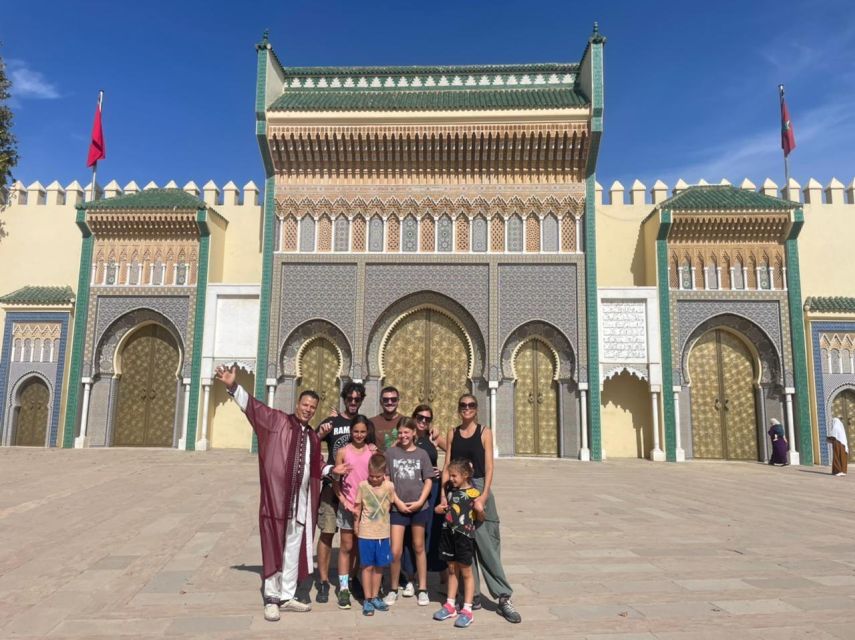
Mohammed’s greatest strength is the way he connects facts with ordinary life. He is described as friendly, humorous, patient, and easy to question. His English is reported as strong, and he learned much of it independently through books and films.
That matters in a city where the most useful questions are often informal ones. You can ask how people use a particular market, why a craft is made in a certain way, how to approach a purchase, or what a neighborhood means to local residents. The answers help you read the city rather than simply pass through it.
His local relationships also shape the experience. He often knows people along the route and can greet artisans or explain their work. At its best, the tour feels like being shown around a hometown, not being marched from one photo stop to another.
The exact guide can vary. Most of the information centers on Mohammed, while one account names Rachid. If having a particular guide matters to you, confirm the name after booking.
Group size, pace, and practical comfort

Private and small-group options are available. A smaller group gives you more room to ask questions and makes it easier to stop for photographs. It also suits anyone who wants to discuss architecture, craft, food, or Moroccan customs in detail.
The route is almost entirely on foot. There is no stated vehicle transfer during the medina walk, and the old city’s narrow lanes are not designed for cars. Wear shoes with a good grip, carry water, and leave space in your schedule after the tour.
Friday can be quieter in some parts of the medina, though religious activity may affect what you see and when you see it. Hot weather is manageable when the route includes shaded lanes and pauses, but the full-day option still requires stamina.
The tour is in English. If you need another language, this experience may not be the right match because English is the only language specified.
Is $22 a good value?
At $22 per person, this is a strong value for a first visit to Fes. You are paying not only for access to a guide but also for orientation in a city where getting lost can eat up much of a morning. The tour covers a large number of major sights in three hours, with the option to spend six hours on the extended route.
Entrance fees are extra, including the stated €4 charge for the madrasa and museum. Food and drinks are also not included. That is fair for a low-cost walking tour, but budget for these small additions and carry cash.
The value improves if you are staying only a day or two. You can see the main monuments, learn the layout, and return later to the markets or museums that interested you most. It is also useful at the start of a longer stay because you gain practical advice before shopping or exploring alone.
Who should book this walk?
I would choose this tour if you want an efficient first look at Fes with a local who can explain culture and craft in plain language. It suits couples, families with older children, solo visitors, and small groups who prefer conversation over a scripted lecture.
It is particularly good for people who worry about aggressive sales tactics. The guide’s usual style is to show workshops and stores without pushing you to buy, and he can help if you do want to shop.
You should think twice if you dislike long walks, uneven ground, narrow lanes, strong smells, or busy markets. The tour is not suitable for people with mobility impairments, and the full-day route is best for those who want a long, active day rather than a short introduction.
Should you book the Fes Medina tour?
Yes, especially if this is your first time in Fes and you want the main sights plus a clearer sense of local life. The half-day option gives you the best balance of coverage and energy. Choose the full day if you want the Jewish Quarter, Royal Palace, pottery, mosaics, and viewpoints without arranging separate transport or guides.
Book it early in your stay, use the first walk to learn the medina’s layout, and tell Mohammed what interests you most. If you want architecture, craft, photography, food advice, or everyday culture, say so at the start. The experience works best when you treat it as a conversation with a local, not simply a checklist of monuments.
FAQ
How long is the Fes Medina tour?
The half-day tour lasts about three hours. A full-day option is also available and lasts roughly three to six hours depending on the selected option and pace.
What sights are included on the half-day route?
The route begins at Bab Boujloud and includes Talaa Kebira, the water clock, Bou Inania Medersa, Kairaouine Mosque and University, the Andalusian Mosque, Nejjarine Fountain, Nejjarine Museum, Henna Souk, Attarin Market, Place Seffarine, Saffarin Madrasa, and Chaouwara Tannery.
What does the full-day option add?
After the Medina visit, the full-day tour adds the Jewish Quarter, the Royal Palace, a mosaic and pottery factory, and panoramic views from Bab Guissa and the Marinid Tomb.
Is entrance to the madrasa and museum included?
No. Entrance fees are separate, with €4 listed for the madrasa and museum.
Is hotel pickup available?
Hotel pickup and drop-off are offered for private tours. You should send the hotel name and address after booking.
Where is the meeting point?
The meeting point is Dar Sunrise, house number 10, in the alley beside the Made in M cafe on Talaa Kebira. It is about three minutes from Bab Boujloud, or about one minute uphill from Ain Zliten Parking.
Is the tour suitable for people with mobility impairments?
No. The experience is not suitable for people with mobility impairments because it involves walking through narrow, uneven Medina lanes.
Just added for Fez
- Day trip to meknes ,volubilis , moulay idris★ 4.5 · 83 reviews
- Hammam &Massage Dar Tahri & SPA★ 4.7 · 78 reviews
- From Marrakech: 2 Days Desert trip back to Fes or Marrakech★ 4.7 · 369 reviews
- From Fes To Marrakech: 2-Days with Luxury Camp, Desert Tour★ 4.9 · 237 reviews
- From Fes: 3-Day 2-Night Desert Tour to Marrakech★ 4.5 · 259 reviews
- From Fes: 2-Day Luxury Desert Tour to Marrakech & Back Fez★ 4.7 · 96 reviews
- Fez: Souk Tour and Traditional Home Cooking Class★ 4.9 · 186 reviews
- Private Tour –In Old Medina of Fez with a Professional Guide★ 4.7 · 146 reviews
Medina & Souk Tours, compared.
Bahia Palace, Saadian Tombs, Souk and Medina Tour
Read our review →
Cairo 8 Hour Private Tour of Pyramids, Egyptian Museum and Bazaar
Read our review →
Ben Youssef, Secret Garden, & Souks Walking Tour
Read our review →
Saadian Tombs & Bahia Palace, Medina Guided Tour
Read our review →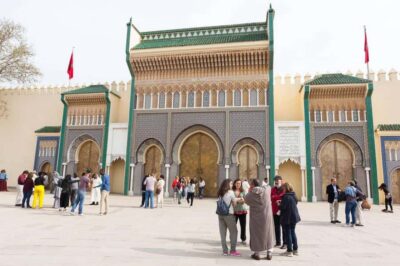
Museum, Al Attarine Madrasa & Tannery and Medina Tour
Read our review →
Browse the lists this tour appears in