
Reviewed · MARRAKECH TOURS
Marrakech: Make Your Own Moroccan Zellige Mosaic Masterpiece
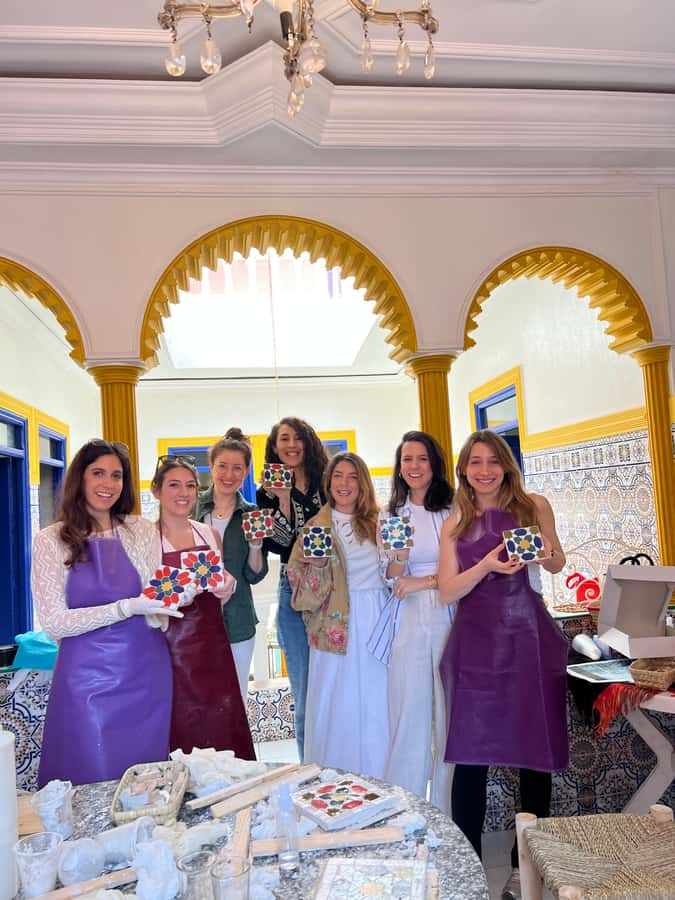
Moroccan zellige is the art of turning small, colorful tile pieces into precise geometric patterns. In this two-hour workshop, you choose a design, arrange the pieces, and leave with a handmade tile that means more than a shop-bought souvenir. I especially like the friendly help from instructors such as Salma, Laila, and Layla, plus the welcome of tea and Moroccan pastries.
I also like that the activity works well for couples, families with older children, and anyone needing a rainy-afternoon plan in Marrakech. The main consideration is that you arrange pre-cut pieces rather than make every tile from raw clay, and color choices may be more limited than you expect.
Key points at a glance

- Create a personal souvenir: Your finished zellige tile goes home with you, and the instructor may add your name in Arabic on the back.
- Helpful multilingual teaching: Instruction is available in Arabic, French, and English, with Salma, Laila, and Layla praised for clear, patient guidance.
- Small-group feel: One session had only six people, though larger groups may need to wait briefly for individual help.
- Tea and pastries included: The break adds a warm Moroccan touch without turning the workshop into a full meal.
- Good rainy-day value: At $42 per person for two hours, the class combines an activity, cultural background, materials, and a keepsake.
- Medina setting: The studio is in or near Marrakech’s Old Town, reached through a side street off a souk.
Why zellige makes a better souvenir than another shop purchase
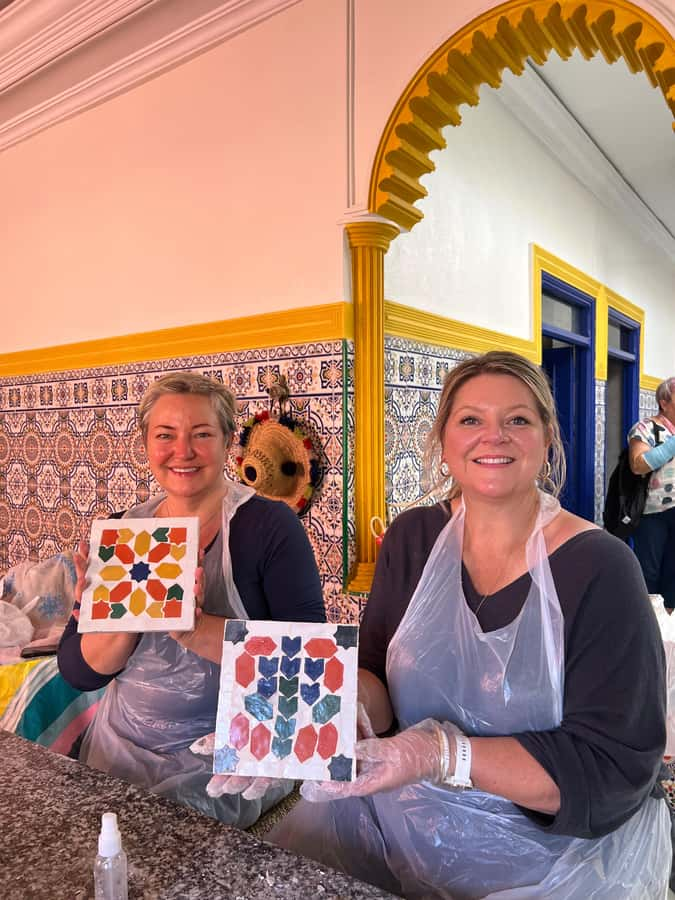
Marrakech is full of things to buy. After a few days of rugs, lanterns, leather goods, and painted ceramics, another object can start to feel like luggage with a price tag. This workshop gives you a hand in making the souvenir, which changes the experience.
Zellige is closely tied to Moroccan architecture. You see its geometric patterns in palaces, houses, fountains, religious buildings, and courtyards. The designs rely on repeated shapes, careful spacing, and strong color contrasts. A small tile gives you a simple way to understand how those larger decorative surfaces come together.
Your finished piece will not be the work of a master tile cutter, and that is part of its charm. It is a personal keepsake made during your time in Marrakech. One instructor even wrote participants’ names in Arabic on the backs of their tiles, a small touch worth requesting if it is available during your session.
I like this format because the souvenir has a story. You remember choosing the colors, working out the pattern, and enjoying tea during the process. That is more useful than simply saying you bought something in the Medina.
More workshops with Marrakech artisans:
- Marrakech: Pottery Workshop with Moroccan Tea
★ 4.8 · 756 reviews - Marrakech: Moroccan Pastries and Tea Class with a Local
★ 4.7 · 84 reviews
Entering the studio near Marrakech’s Medina
The workshop takes place in a spacious, well-ventilated studio in the Old Town area. One family described reaching it through a side street off a souk, so getting there can form part of the experience. You get a look at a quieter slice of the Medina while moving away from the main shopping lanes.
The studio setting has a rustic Moroccan feel, according to the details available about the space. It is also air-conditioned, which matters in Marrakech’s hotter months. The combination of a traditional craft and a comfortable workroom makes this a sensible break from walking outside.
You should arrive about 15 minutes early. That gives you time to settle in, find your place, and listen to the opening explanation without feeling rushed. Wear clothes you can work in comfortably. This is a hands-on craft session, not a formal demonstration where you sit back and watch.
The space is not suitable for wheelchair users, and children under five cannot take part. Families with older children have enjoyed it, including one parent who worked with two daughters under 10, but younger children may need close help with the small pieces and pattern work.
The opening lesson: history, shapes, and Moroccan design
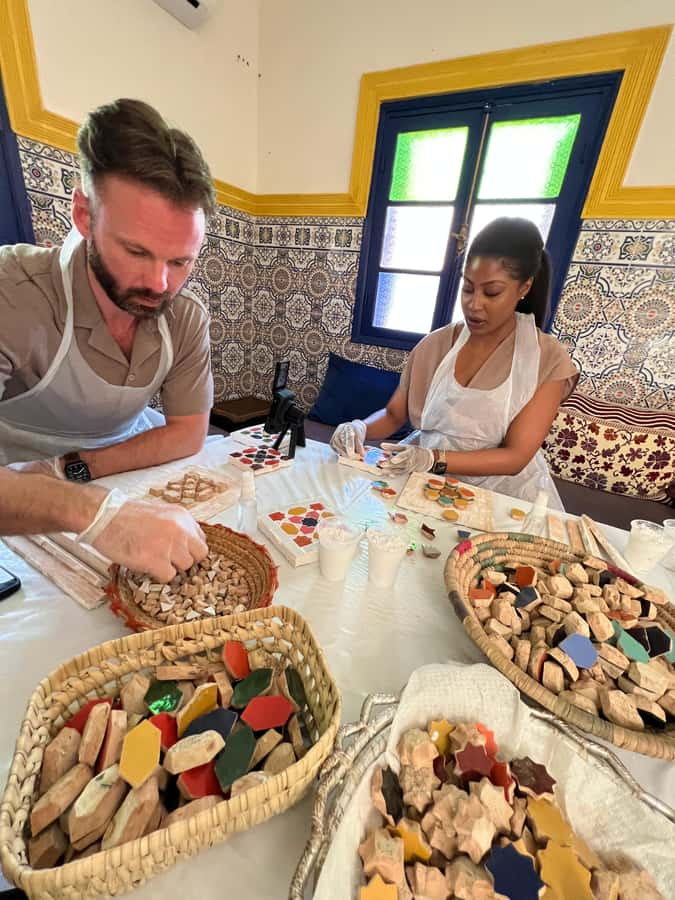
The class begins with an introduction to zellige and the methods used to create it. You learn why the craft matters in Moroccan architecture, how geometric designs are arranged, and how individual pieces fit into a larger pattern.
This short background makes the practical work easier to understand. Instead of seeing a wall of tiles as a blur of color, you start noticing repetition, symmetry, and the way a few basic shapes can form a complex design.
The instructors use examples and proposed patterns to show you the process. This is useful if you do not have an artistic background. The activity is designed for beginners, so you are not expected to arrive knowing how Moroccan tile patterns work.
The teaching style appears to be a major strength. Salma has been praised for explaining the history and techniques clearly, while Laila and Layla are noted for being encouraging and patient. That matters because the pieces can look confusing at first. One participant specifically found the early arrangement muddled, then felt comfortable after Layla’s help.
The class is available in Arabic, French, and English. If you want more cultural context, ask questions during this opening section. The workshop gives you a useful introduction, though it is not a full course in Moroccan architecture or traditional tile production.
Choosing colors and arranging your pattern

Once the demonstration is over, you select your colors and begin arranging the pieces. The tile elements are pre-cut, so the focus is on design and assembly rather than shaping and cutting raw material.
That makes the class approachable and keeps the two-hour schedule realistic. You can concentrate on the creative decisions: which colors work together, how the shapes repeat, and how to keep the pattern balanced. Examples are available to help you get started, but you still have room to make a design that feels like yours.
You should know that the range of colors may be more limited than expected. One participant also felt that there was not enough advice on color selection. If you are unsure, ask the instructor before committing to your arrangement. A quick suggestion about contrast or repetition can make the finished tile look more deliberate.
The workshop is not about racing to produce a perfect pattern. It is about learning how the parts fit together and seeing the design develop in front of you. I would choose a pattern with clear repetition rather than trying to invent something too complicated. The geometric nature of zellige rewards order.
This is also the point where the group size matters. A six-person session offers a comfortable amount of individual attention. In a bigger group, you may need to wait briefly while the instructor moves from one table to another. Even so, Laila was described as attentive despite handling a large group.
A few more Marrakech trips worth putting side by side
- Marrakech: Quad Bike Tour to Palm Oasis and Jbilat Desert
★ 4.8 · 11,831 reviews - Marrakesh: Majorelle Garden Entry Tickets
★ 4.5 · 9,651 reviews - Marrakech Quad Bike Experience: Desert and Palmeraie
★ 4.5 · 9,509 reviews - Marrakech: Balloon Flight, Berber Breakfast & Certificate
★ 4.8 · 8,164 reviews
The hands-on stage and the finished tile

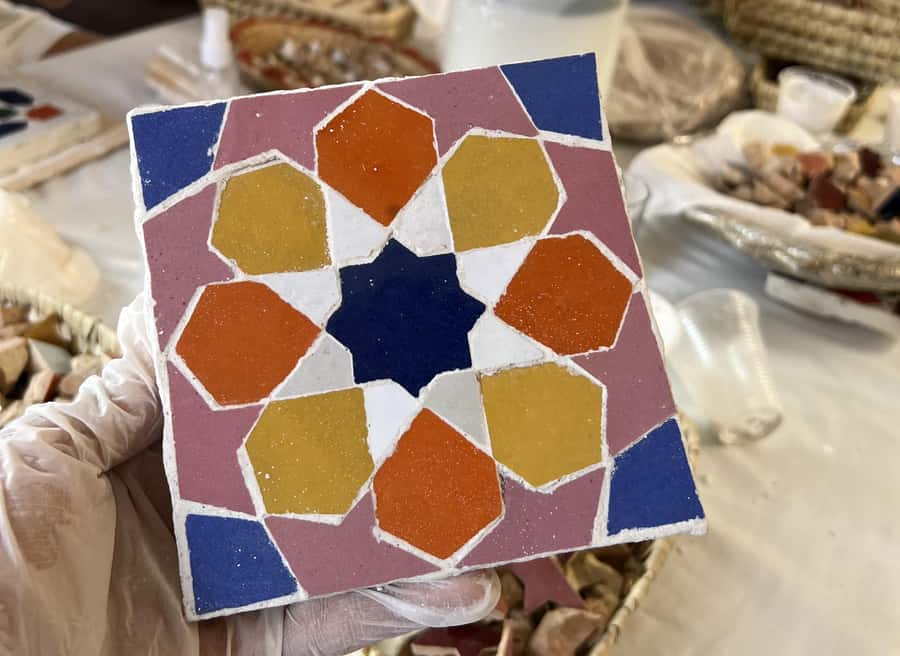
As your pattern takes shape, the instructor helps you correct spacing, placement, and any pieces that seem out of order. This is where the activity becomes more than a craft kit. You get a feel for the patience and precision required by Moroccan mosaic work.
The finished tile is included in the price and is yours to take home. It is a practical size for packing, though the exact dimensions are not specified. Handle it carefully when you leave, especially if you are continuing your trip before flying home.
Some participants have described being surprised by how impressive the final product looks. That is partly because geometric designs gain strength as the pieces come together. A single loose shape may not seem special, but the completed arrangement has a clear Moroccan character.
The instructor may personalize the back with your name in Arabic. This is not listed as a guaranteed part of every session, so ask politely if you would like it. It is a nice detail for a couple, family, or solo visitor who wants the object tied clearly to the trip.
The finished tile is also easy to explain when you get home. You can point to the design and describe how you learned to arrange the pieces in a Marrakech studio. That story adds value without requiring you to buy a large or fragile object.
Tea, pastries, and a relaxed pace
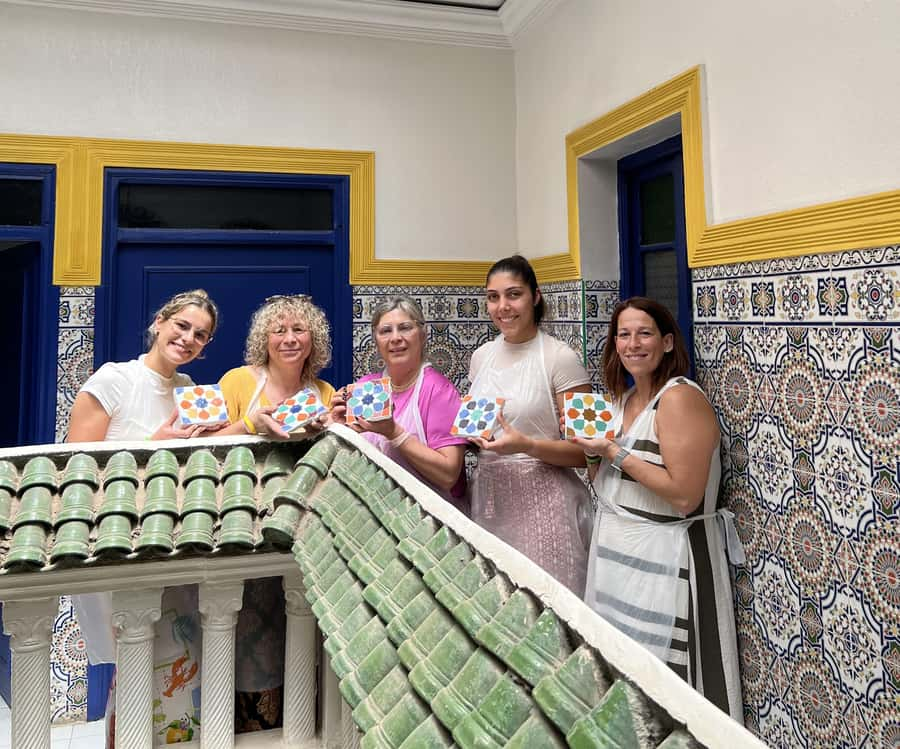
Tea and Moroccan pastries are included. They are not a replacement for lunch or dinner, since meals are not part of the activity, but they add a pleasant pause during the class.
The tea break fits the mood of the workshop. This is a calm, creative activity, and the refreshments give you a moment to look at your design before returning to the table. It also helps make the experience feel connected to Moroccan hospitality rather than like a generic art class.
You should bring water, especially during warm weather. The studio is well ventilated and air-conditioned according to the available details, but you may still want your own drink while working.
Smoking is not allowed. Bring a camera if you want pictures of the studio, your materials, or the finished piece. Ask before photographing other people or the instructor at work.
Is $42 a fair price?
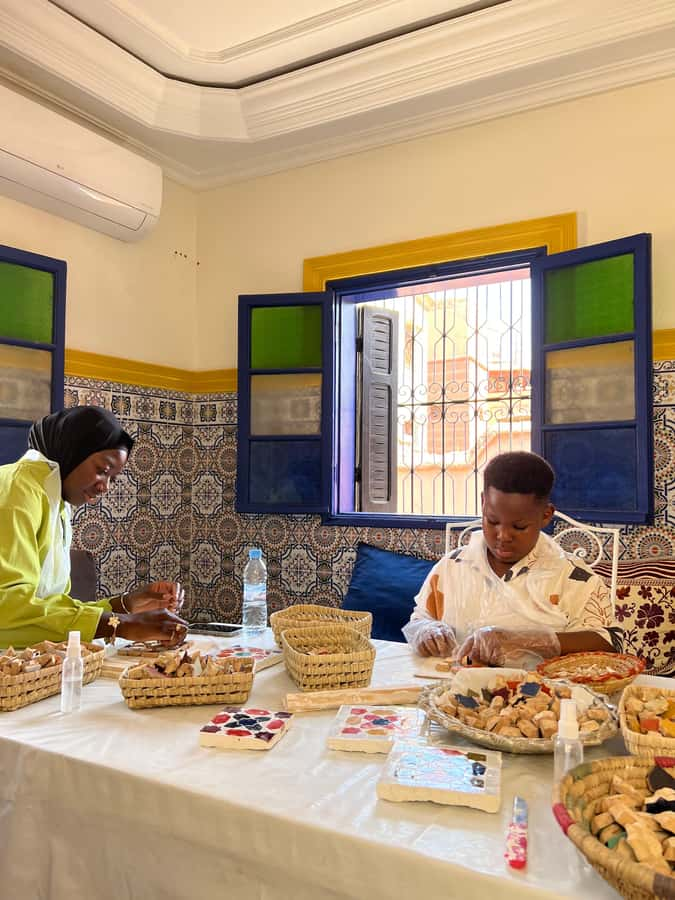
At $42 per person, the workshop is not the cheapest way to spend two hours in Marrakech, but the price covers several useful elements: expert instruction, all materials, tea, Moroccan pastries, and a finished piece to take home.
I consider that good value for visitors who want an activity rather than another sightseeing stop. You are paying for guidance and a cultural introduction, not just for a tile. The personal keepsake gives the class a lasting purpose.
The value is strongest for couples and families. Two people can make separate designs and compare them afterward. Families can work side by side, giving each person a souvenir with a different pattern. Teenagers aged 14 and 16 have enjoyed the process, and younger children have also taken part with parental support.
The price makes less sense if you want a full technical course. The workshop introduces zellige and gives you practical experience, but one session will not teach every stage of traditional production. Pre-cut pieces keep the activity accessible, though they also limit how much raw tile-making technique you learn.
For a two-hour activity in central Marrakech, with materials and refreshments included, the cost is reasonable. It is especially useful on a rainy afternoon or after several days of palace visits and souk shopping.
Who will enjoy this most?
I would recommend the workshop to:
- Couples who want a shared activity and a useful keepsake
- Families with children old enough to handle small craft pieces
- Visitors interested in Moroccan architecture and decorative arts
- People who prefer making a souvenir to buying one
- Anyone looking for an indoor activity during hot or wet weather
- Beginners who want clear guidance rather than a demanding art course
You do not need drawing skills. The proposed patterns and instructor support give you a practical starting point. The activity suits artistic people, but it also works for anyone curious about Moroccan design.
I would be more cautious if you dislike detailed, repetitive work or expect to manufacture tiles from clay yourself. The task centers on arranging pre-cut pieces. You also need to be comfortable in a non-wheelchair-accessible studio.
Timing, language, and useful planning tips
The activity lasts two hours, with starting times available according to the selected date. Plan a little extra time around it for finding the studio in the Medina and arriving 15 minutes early.
Transportation is not included, so you make your own way to the workshop. The precise pickup arrangement is not provided, so check the meeting details carefully when booking.
Instruction is offered in Arabic, French, and English. The English guidance has been described as clear, which should help if you want to follow the design explanation and ask questions as you work.
Free cancellation is available up to 24 hours before the start time for a full refund. You can also reserve now and pay later, which helps if you are still adjusting your Marrakech schedule. These policies are useful, but check the current booking terms before confirming.
My verdict: book it if you want a personal Marrakech memory
I would book this workshop if you want a hands-on look at Moroccan craft, a relaxed two-hour break, and a souvenir you helped create. The strongest parts are the patient instruction, the friendly atmosphere, and the chance to leave with a finished zellige tile rather than just another purchase.
Keep your expectations sensible. You will work with pre-cut pieces, the color range may be limited, and a large group could mean less immediate help. Still, the $42 price is fair for the instruction, materials, refreshments, and personal result.
Choose it for a couple’s activity, a family afternoon, or a rainy-day plan in Marrakech. Skip it only if you want a full artisan apprenticeship or have mobility needs that make the studio unsuitable.
FAQ
How long does the zellige workshop last?
The workshop lasts two hours.
What is included in the price?
The price includes expert instruction, all workshop materials, tea, Moroccan pastries, and a piece of your own zellige artwork to take home.
How much does the activity cost?
The listed price is $42 per person.
What languages are spoken during the workshop?
Instruction is available in Arabic, French, and English.
Do I need previous artistic experience?
No. The workshop is designed for all skill levels, including beginners. Instructors explain the patterns and help you arrange the pieces.
Can I take my finished mosaic home?
Yes. Your completed zellige artwork is included and can be taken home as a souvenir.
Is the workshop suitable for children?
Children under five are not permitted. Older children may take part, with family groups having enjoyed the activity.
Is transportation included?
No. Transportation to and from the workshop is not included.
Can I cancel my booking?
Yes. You can cancel up to 24 hours in advance for a full refund. Reserve now and pay later is also available.
Just added for Marrakech
- Marrakech: Tailor-Made City Tour With Your Own Private Guide★ 4.9 · 236 reviews
- Marrakech palm grove: Sunset camel ride★ 4.8 · 194 reviews
- Sparkling Marrakech through the eyes of your local Guide★ 4.7 · 247 reviews
- Quad Bike Activity in Marrakech Palmeraie★ 4.2 · 123 reviews
- Marrakech: Historical Discovery Tour★ 4.1 · 87 reviews
- Marrakech: Palm Grove Horseback Riding Tour★ 4.6 · 163 reviews
- Moroccan Food Cooking Class with a Local Chef in Marrakech★ 4.7 · 90 reviews
- Marrakech: Babouch Making Workshop in the Medina★ 4.9 · 117 reviews
Marrakech Tours, compared.

Quad Bike Tour to Palm Oasis and Jbilat Desert
Read our review →
Marrakech Quad Bike Experience: Desert and Palmeraie
Read our review →
Balloon Flight, Berber Breakfast & Certificate
Read our review →
Desert & Mountain Tour with Camel Ride & Lunch
Read our review →

Majorelle Garden, YSL, and Berber Museum Entry
Read our review →
Dunes of the Palmeraie Quad Bike Ride with Tea
Read our review →Browse the lists this tour appears in