

Reviewed · WALKING TOURS
Johannesburg: City Centre Walking Tour
Johannesburg’s city centre makes the most sense when you walk it. This tour links gold-mining sites, courts, old office buildings, Mandela’s former law firm, Newtown’s arts venues, and the Nelson Mandela Bridge into one clear story. I especially like the focus on Johannesburg’s everyday reality, not just polished shopping districts, and the way guides such as Refiloe bring history and current city politics into the same conversation.
I also like that the tour shows you parts of the CBD you might not feel ready to explore alone, while keeping the route focused and manageable at about three hours. The main caution is that conditions and access can change. The Workers Museum may be closed, and you should not assume that the Carlton Centre offers its former observation experience. The supplied information also calls the tour wheelchair accessible but says it is not suitable for wheelchair users, so confirm access before booking.
Key points at a glance

- Gandhi Square to Ferreirasdorp: Start with Johannesburg’s gold-mining beginnings and the first diggers’ settlement.
- Mandela and Tambo’s law office: Visit Chancellor House, a powerful stop for understanding apartheid-era legal and political work.
- Newtown’s working-class past: The Workers Museum explains migrant labour and the lives behind the city’s mines.
- Courts and civic buildings: See the High Court, Magistrate’s Court, Marshalltown Post Office, and major office architecture along the way.
- Artistic Johannesburg: Pass Mary Fitzgerald Square and the Market Theatre before heading toward Braamfontein.
- Guides who shape the experience: Refiloe, Thabo, Mulalo, Mathapelo, and other local guides have been praised for clear explanations, warmth, humour, and care with route choices.
Why walk Johannesburg’s CBD?
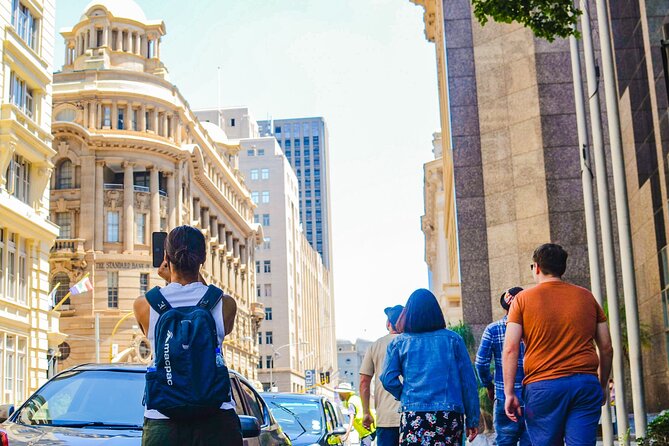
Johannesburg can be easy to misunderstand from a car window. Sandton gives you towers, hotels, malls, and corporate offices. The central city gives you the harder, more revealing story: gold, migrant labour, apartheid, legal resistance, urban change, street life, and a creative scene that keeps pushing forward.
This walk is built around that story. You start at Nando’s outside Gandhi Square, in the Metropolitan Building area, and move through Marshalltown, Ferreirasdorp, Newtown, and toward Braamfontein. The route is not a collection of unrelated photo stops. It connects the city’s first gold rush to the way Johannesburg works and struggles today.
I like this approach because you get context before you reach the famous names. Nelson Mandela is part of the route, but he is not treated as a single isolated monument. His work with Oliver Tambo appears within a larger account of law, race, business, and political change.
You should also expect an honest discussion of the CBD’s present condition. The guide may talk about vacant or occupied buildings, squatters, public safety, city management, and the gap between Johannesburg’s potential and its current problems. That can be uncomfortable, but it is useful. This is not a polished sightseeing circuit designed to hide the rough edges.
More Walking Tours in South Africa
- Soweto: Walking Tour with a Local Guide and Lunch
★ 4.9 · 648 reviews - Johannesburg: Local Food Tasting Guided Walking Tour
★ 4.7 · 192 reviews - Plettenberg Bay: Bungee Jumping with Zipline and Sky Walk
★ 5.0 · 506 reviews
Gandhi Square and Johannesburg’s gold beginnings
The meeting point is outside Nando’s at Gandhi Square. Arrive with comfortable shoes, water, and a little patience while you locate your guide in the Metropolitan Building area.
From here, the tour begins to explain how Johannesburg grew from gold discoveries into a major South African city. Main Street and the surrounding buildings provide the setting for a discussion of mining money, early settlement, and the architecture that followed. You will not simply hear that gold made Johannesburg important. You will see how the wealth shaped streets, offices, courts, and public buildings.
The Carlton Centre is scheduled as a 20-minute guided stop. It is one of the city centre’s best-known landmarks and helps you understand the scale of Johannesburg’s commercial core. However, do not book this walk solely for a high-level skyline view. Access to the former Carlton Towers viewing experience has changed, and a past visitor found that the expected 360-degree view was no longer available.
That does not make the stop pointless. It means you should treat the Carlton Centre as part of the city story, not as a guaranteed observation deck visit. Ask the guide what is open on your date.
Courts, post offices, and the architecture of power
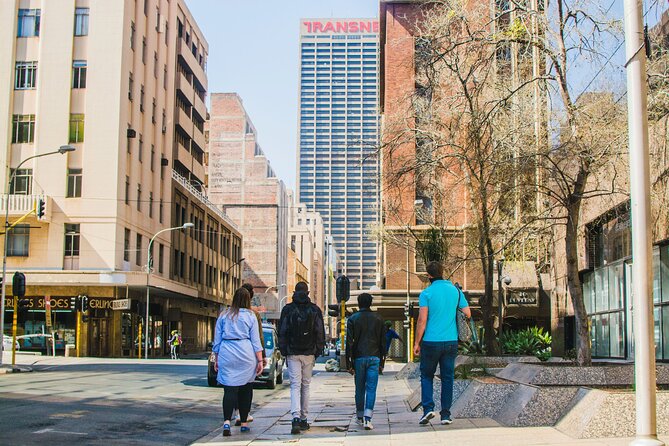
The next section moves through buildings that help explain who governed, judged, and administered Johannesburg.
The High Court of South Africa, Gauteng Local Division, receives about 20 minutes. It is both a photo stop and a chance to discuss the legal system and the city’s political past. The Johannesburg Central Magistrate’s Court adds another 20 minutes later in the walk.
These places matter because Johannesburg’s history is not only about mines and famous leaders. Courts reveal how laws were enforced, challenged, and experienced by ordinary people. A guide can point out the difference between simply admiring a façade and understanding what happened inside it.
The Marshalltown Post Office gets around 10 minutes. This shorter stop helps break up the larger historical sections and gives you another example of civic architecture. Marshalltown itself receives about 30 minutes of walking, guided explanation, and photo stops.
I like the variety here. You are not asked to spend three hours looking only at statues. You move between office buildings, public institutions, streets, and neighbourhoods. The result feels closer to reading a city than checking off monuments.
Ferreirasdorp and Chancellor House
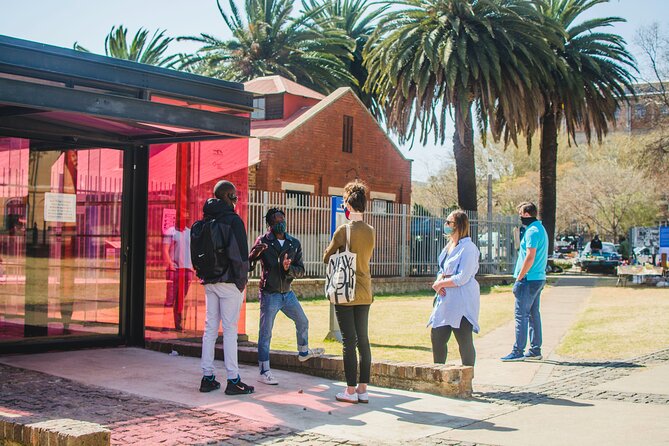
Ferreirasdorp is sometimes called the cradle of Johannesburg. The first gold diggings began here, and early diggers settled in the area. That gives the tour a strong physical connection to the city’s origin story.
This is one of the most useful parts of the walk for first-time visitors. Johannesburg can seem young and relentlessly modern, but Ferreirasdorp brings you back to the first settlement and the rush for gold. The guide can explain how mining drew people, money, labour, and conflict into the same place.
The route then reaches Chancellor House, associated with Nelson Mandela and Oliver Tambo’s first black-owned law firm. This is not just a Mandela photo opportunity. It is a place to consider the practical work of resistance: legal advice, personal cases, racial discrimination, and the limits placed on black professionals under apartheid.
I would pay close attention here. Visitors often know Mandela as a national leader, but this stop shows an earlier phase of his life, when he and Tambo worked directly with people facing an unjust legal system. The setting makes the political story more human and more specific.
More Walking Tours in Johannesburg & Pretoria:
- Marrakech: Ben Youssef, Secret Garden, & Souks Walking Tour
★ 4.6 · 2,802 reviews - Marrakech: Colorful Medina Souks Guided Walking Tour
★ 4.7 · 2,470 reviews - Explore Fes: Unforgettable Guided Walking Tour of the Medina
★ 4.7 · 1,339 reviews - Nairobi: Historic and Modern Highlights Walking Tour
★ 4.8 · 703 reviews
Beyers Naude Square and the city’s working centre
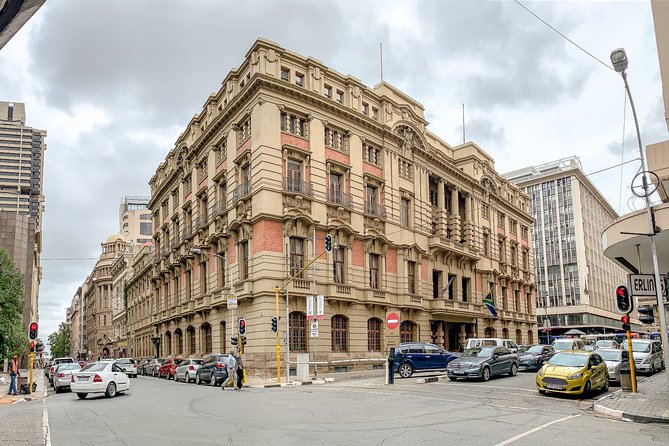
Beyers Naude Square is another point for photos, sightseeing, and discussion. The square sits within the central city route and helps you see the contrast between older civic spaces and the way people use them now.
The walk also passes the Anglo American corporate office. This stop links the city’s present-day corporate identity to the mining companies that shaped Johannesburg’s economy. You may find the building itself less emotionally powerful than Chancellor House or the Workers Museum, but it helps complete the picture.
The tour is strongest when it holds these different sides together. Johannesburg is not only a story of oppression, and it is not only a story of economic success. It is a city formed by corporate power, labour, law, migration, politics, and daily survival.
The Workers Museum and migrant labour
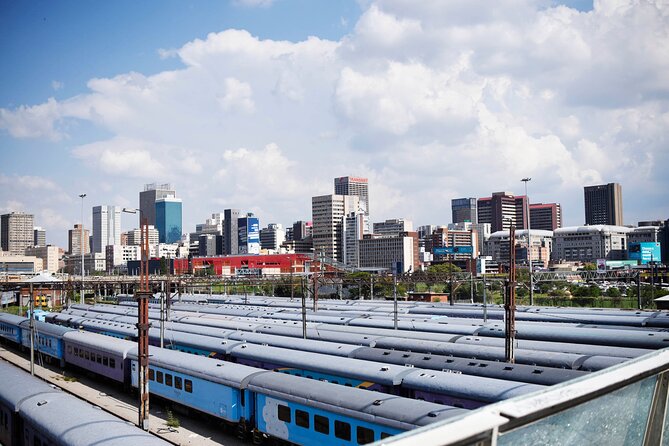
The Workers Museum is scheduled for about 15 minutes. It is one of the most important stops because it shifts attention away from company owners and major political figures toward workers and families.
The museum explains migrant labour, a system that brought workers to Johannesburg’s mines while separating many of them from their homes and families. That history is central to South Africa’s urban story. The mines needed labour, but the social and personal cost was enormous.
You should check the museum’s opening schedule before you go. It has been closed on some Mondays, and access is not guaranteed every day. If the doors are shut, the guide can still explain the working and living conditions associated with migrant labour, but you will miss the displays and interior setting.
That possibility is worth knowing in advance. The museum is not a bonus detail. It is one of the stops that gives the gold-mining story a human scale.
Newtown, Mary Fitzgerald Square, and the Market Theatre
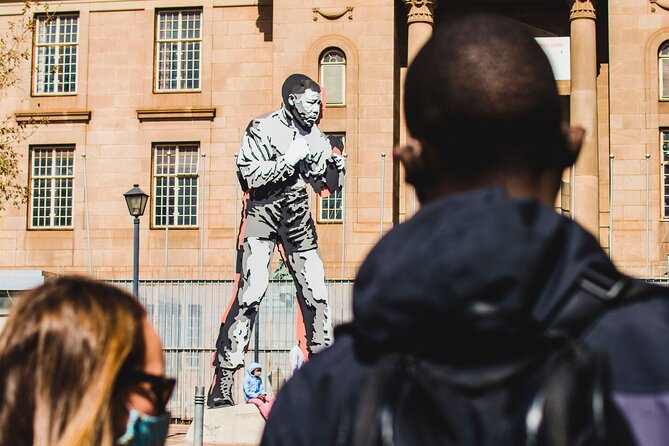
Newtown is one of Johannesburg’s main creative districts, and the walk gives you time to see its cultural side without separating it from its industrial and working-class past.
Mary Fitzgerald Square receives roughly 15 minutes. It is a useful public space for understanding Newtown’s role in music, performance, street art, galleries, and community events. The area has a different feel from the courts and corporate offices earlier in the walk.
The Market Theatre is a shorter five-minute pass-by, but its importance is larger than the time suggests. The theatre has a strong connection to South Africa’s cultural and political life. Your guide can place it within the story of artists and performers who challenged official ideas during apartheid and helped create a public space for difficult subjects.
Do not expect a long theatre visit here. It is a guided pass-by rather than a performance or backstage tour. Still, it helps explain why Newtown matters and why Johannesburg’s culture cannot be reduced to museums and formal memorials.
Nelson Mandela Bridge and the walk toward Braamfontein
The Nelson Mandela Bridge is one of the route’s best photo points. The tour allows about 10 minutes for the bridge, scenic views, and guided explanation, with the walk leading toward the finish in Braamfontein.
The bridge connects areas of the city and works well as a symbol of Johannesburg’s different neighbourhoods. You get a change of view after the tighter streets of the CBD, plus a clear place to take photographs.
The tour finishes at Sha’p Braai, a shisanyama restaurant. Lunch is not included, but this ending gives you the option of eating after the walk. A previous visitor specifically praised the food, so I would consider keeping time and money aside for a meal if you want to finish with a local-style dining experience.
Braamfontein is described as a newer artistic hub with a youthful energy. The route does not promise an extended neighbourhood tour here, so think of it as the final setting and a useful place to continue exploring rather than a full second walking tour.
The guides make the difference
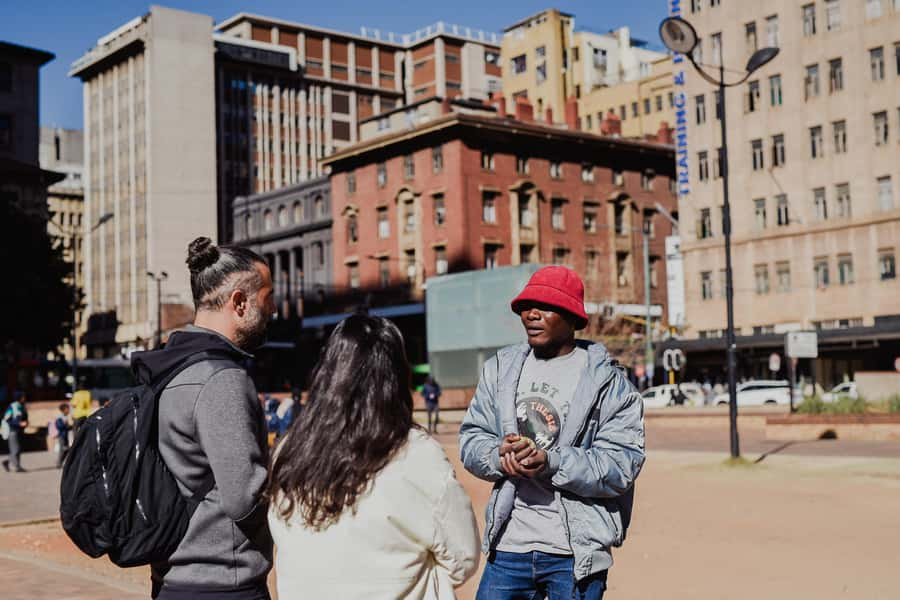
The quality of this experience depends heavily on the guide. The strongest reports name Refiloe repeatedly, along with Thabo, Mulalo Mphuma, Mathapelo, Clement, Tebogo, and other local guides.
Refiloe is described as warm, funny, careful, and exceptionally well informed about Johannesburg and South African history. Several tours became longer than planned when he had time to show more of the CBD. One three-hour outing lasted about four hours because the group was small and he continued explaining the city.
That flexibility can be a real advantage, but it also means you should not schedule something tightly after the tour. The stated duration is three hours, though a private or lightly booked tour may run longer.
The guides are also praised for helping people feel comfortable on the route. That does not mean you should ignore normal city precautions. Keep valuables secure, listen to local advice, and stay with the group. The point is that a local guide can make route decisions and explain what you are seeing in a way a self-guided walk cannot.
Safety, walking effort, and practical limits
Safety is a major reason to consider this tour. Several people specifically appreciated being able to walk through the CBD with a guide and said they felt looked after. The tour offers a structured route through areas some visitors might not choose to enter alone.
Still, this is a city-centre walking tour, not a gentle sightseeing shuttle. Wear supportive shoes, carry only what you need, and bring water. Bottled water is included, but Johannesburg’s streets and changing conditions can make the walk more tiring than the timetable suggests.
The activity information gives conflicting accessibility details. It says the tour is wheelchair accessible, but it also lists wheelchair users among those for whom it is not suitable. Because the route includes several streets, walking sections, and older urban areas, contact the operator before booking if you need step-free access.
Pregnant women are also listed as unsuitable for the activity. That is another reason to ask the operator directly if your mobility needs or health situation are not straightforward.
Is $40 good value?
At $40 per person, the tour is priced above a casual self-guided walk, but the value comes from the explanation and route planning rather than expensive attractions.
Entrance fees and bottled water are included, as is the live English-speaking guide. Hotel pickup, drop-off, and lunch are not included. You are paying for about three hours of local interpretation across a wide section of Johannesburg, including places that can be difficult to connect on your own.
I think the price is fair if you want history, politics, architecture, and current city life in one outing. It is less compelling if you only want landmark photos or a panoramic view. The Carlton Centre access may change, and the Workers Museum may be closed, so the value rests mainly on the guide-led walk rather than guaranteed interior access.
Free cancellation up to 24 hours before the start and reserve-now, pay-later booking add useful flexibility. Check the available start time, and leave room in your schedule in case the guide extends the walk.
Who should book this walk?
I would recommend it to you if you want to understand how Johannesburg became Johannesburg. It suits curious first-time visitors, history fans, architecture enthusiasts, and anyone who wants more than Sandton’s malls and office towers.
It is also a good choice if you are uneasy about exploring the CBD alone but still want to see it on foot. The guide provides local direction, context, and a sense of where to focus your attention.
You may prefer another activity if you dislike city walking, want a formal museum-heavy tour, or need fully confirmed wheelchair access. Families can join because all ages are welcome, but young children must be comfortable walking for several hours and listening through historical discussions.
Should you book the Johannesburg City Centre Walking Tour?
Book it if you want the city’s complicated story, not a polished postcard. The route covers gold, labour, law, Mandela, architecture, theatre, public space, and today’s urban challenges, with guides who bring warmth and humour to serious subjects.
Before booking, confirm two details: the Workers Museum’s opening status and the current access arrangements at the Carlton Centre. Also clarify the wheelchair policy if relevant. If those points work for you, $40 buys a thoughtful introduction to Johannesburg’s CBD and a much better sense of why the centre still matters.
FAQ
Where does the Johannesburg City Centre Walking Tour start?
The tour starts outside Nando’s Restaurant at Gandhi Square, in the Metropolitan Building area.
Where does the tour finish?
It finishes at Sha’p Braai, a shisanyama restaurant in the Braamfontein area.
How long does the walking tour last?
The stated duration is three hours. A small or private group may sometimes continue longer, so avoid scheduling another activity immediately afterward.
What language is the tour conducted in?
The live guided tour is conducted in English.
What is included in the price?
The price includes the walking tour, guide, entrance fees, and bottled water.
Is lunch included?
No. Lunch is not included, though the tour finishes at Sha’p Braai, where you can choose to eat.
Does the tour visit Nelson Mandela’s law firm?
Yes. The route includes Chancellor House, where Nelson Mandela and Oliver Tambo established their first black-owned law firm.
Will I enter the Workers Museum?
The Workers Museum is part of the planned route, but it may be closed on some days, including Mondays. If it is closed, the guide can still discuss migrant labour and working conditions.
Is the Carlton Centre observation deck included?
The Carlton Centre is a planned stop, but access to the former 360-degree viewing experience may no longer be available. Confirm current access before booking if the view is important to you.
Is the tour wheelchair accessible?
The information is conflicting: it describes the activity as wheelchair accessible but also says it is not suitable for wheelchair users. Contact the operator before booking to confirm whether the current route meets your needs.
Just added for Johannesburg & Pretoria
- Soweto: Bike Tour with a Local Tour Guide★ 4.7 · 114 reviews
- From Johannesburg: Lion & Safari Park Half-Day Tour★ 4.6 · 384 reviews
- Johannesburg: Soweto Half-Day Tour★ 4.7 · 196 reviews
- Johannesburg: Street Art and Culture in Maboneng!★ 4.8 · 107 reviews
- Johannesburg: Maboneng Street Art & Culture Tour★ 4.9 · 257 reviews
- Johannesburg: Soweto & Apartheid Museum Half-Day Tour★ 4.9 · 99 reviews
- Johannesburg: Soweto Apartheid & Township Tour with Lunch★ 4.8 · 80 reviews
- Johannesburg and Soweto Apartheid Full Day Tour w/Lunch★ 4.9 · 219 reviews
Walking Tours, compared.
Ben Youssef, Secret Garden, & Souks Walking Tour
Read our review →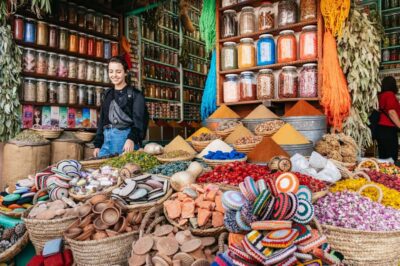
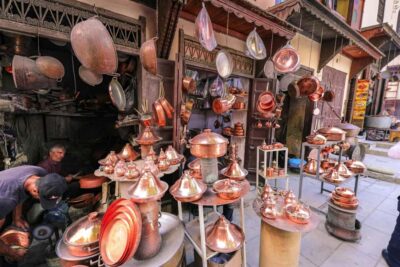
Explore Fes: Unforgettable Guided Walking Tour of the Medina
Read our review →
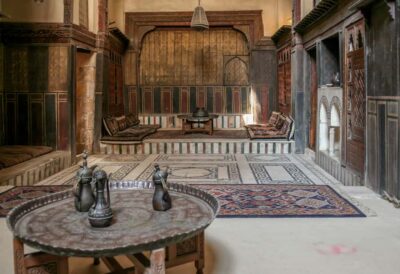
Old Cairo Guided Walk Tour: History, Culture & Street Bites
Read our review →

Plettenberg Bay: Bungee Jumping with Zipline and Sky Walk
Read our review →
Walking Tour Through Old Town Mombasa and Fort Jesus
Read our review →Browse the lists this tour appears in